



Dallas Didn’t Shut Down a Sex Party. It Shut Down a Business.
The $35 Ticket Was the Legal Trigger
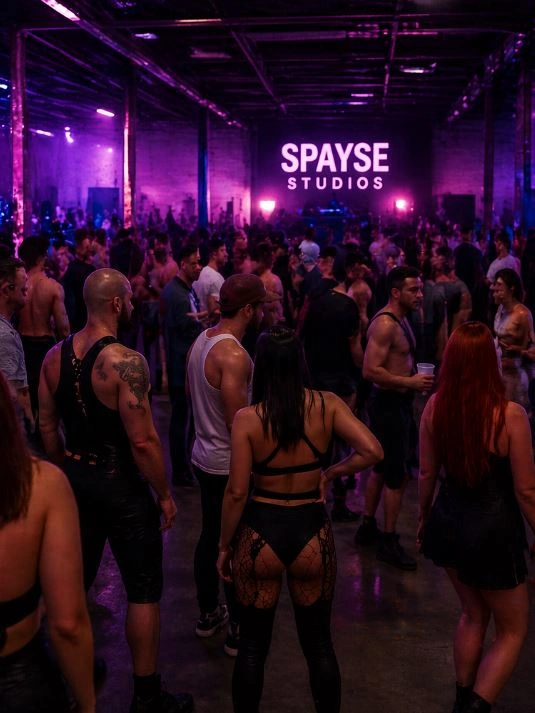
When Dallas vice officers executed a search warrant on a northwest Dallas warehouse on April 18, 2026, they found 50 people, a ticketing system, and a business model that nobody had bothered to license.
The sex wasn’t illegal. The business model was — and that distinction is one most adult operators still don’t understand.
Mike Bradley
The gathering operated under the name Spayse Studios, located in the 2500 block of Manana Road. Attendees told officers they had paid $35 each for consensual adult access. That admission fee, not the activity inside, is what brought the entire operation within the scope of the Dallas Sexually Oriented Business Ordinance, the city’s primary regulatory framework for venues where adult activity occurs commercially. According to the arrest affidavit and current enforcement interpretation, one ticketed gathering with a $35 entry fee and social media promotion was enough to trigger the classification.
Details in business is a must.
Two men were arrested: Israel Luna, 53, and Marc Tuton, 42. Both face charges of operating a sexually oriented business without a license, a Class A misdemeanor. Luna faces additional charges including possession of a controlled substance over 400 grams, a first-degree felony, and promotion of prostitution. Officers also found 227 grams of marijuana, 671 grams of psilocybin mushrooms, and more than 11,000 grams of THC hash oil on the premises.
The 50 attendees were released after a warrant check came back clean.
What happened at Spayse Studios was not unusual as a vice operation. What makes it significant is the legal mechanism that made it possible, and how cleanly it maps onto practices happening across the adult creator economy right now.
What the Dallas SOB Ordinance Actually Says
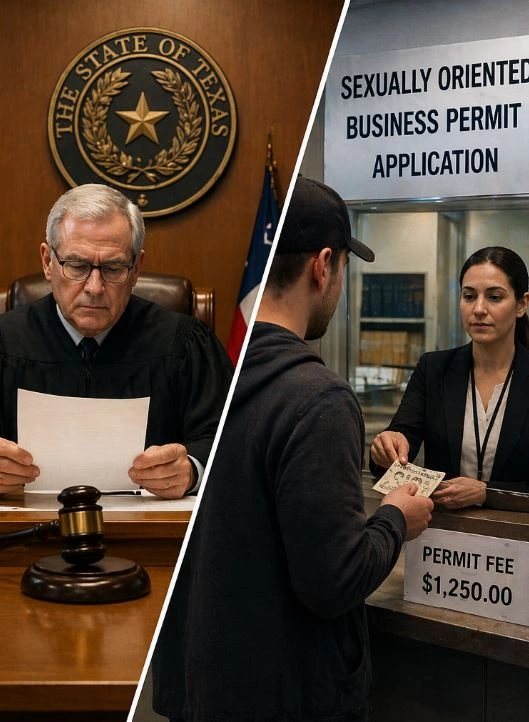
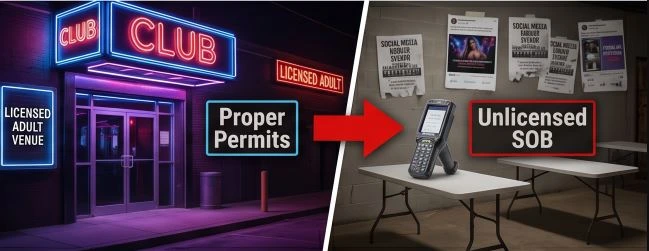
Dallas regulates sexually oriented businesses under its municipal Sexually Oriented Business Ordinance, which the city tightened in 2023. After a court challenge delayed enforcement, those tightened restrictions are now actively applied. The ordinance requires any venue operating commercially in connection with adult sexual activity to obtain a city-issued license before opening.
The word “commercially” is doing a lot of work in that sentence.
More Buzz

The moment Spayse Studios charged admission, it became a business in the city’s view. It did not need a storefront. It did not need a sign. It did not need a history.
Most operators assume staying “private” keeps them compliant. In practice, the moment money changes hands, privacy stops mattering.
Licensed adult venues, clubs, theaters, and retail spaces have navigated this framework for decades. They apply for permits, pay licensing fees, agree to inspections, and operate within defined zoning. The process is bureaucratic and, in many cities, openly hostile. But it exists, and it provides legal cover that Spayse Studios did not have.
Similar ordinances exist in cities like Houston, Miami, and Los Angeles, each with different thresholds for what constitutes a regulated adult business. The Dallas case is the most recent enforcement action, but the underlying regulatory logic is national.
Who This Actually Affects
This is not a niche Dallas story. It is a direct warning for a specific category of adult operator that is growing fast and largely unaware of its regulatory exposure.
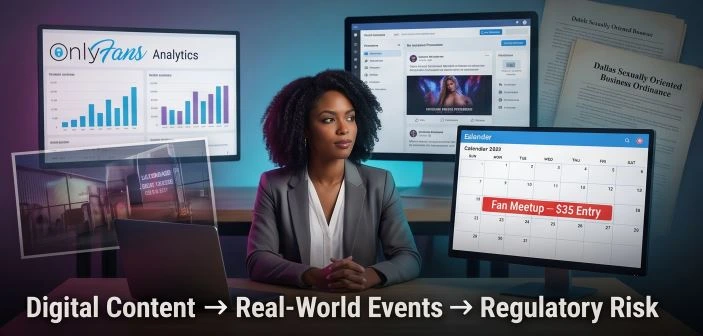
OnlyFans creators hosting private fan meetups that include adult activity and charge for entry are operating in the same legal gray zone Spayse Studios occupied.
Swinger and lifestyle event organizers running ticketed gatherings, even one-off events with no fixed venue, face the same classification risk under local SOB ordinance language.
Pop-up adult party brands promoting through social media and collecting admission are building commercial businesses whether they intend to or not. The promotional record alone establishes commercial intent.
Content houses filming group scenes with paid participants may trigger both SOB ordinance classification and production permit requirements, depending on jurisdiction.
Token-gated and members-only communities offering real-world access have not been tested in court in most cities, which is not the same as being protected.
The common thread is monetization. Any time adult activity and financial transactions overlap in a physical space, local ordinance may define the result as a regulated business. The specific trigger varies by city, but admission fees, recurring promotion, and documented financial gain are consistently cited factors.
Most creators running these events are not doing so with legal counsel. Most have not researched whether their city has a sexually oriented business ordinance, what activities it covers, or what compliance would require. That knowledge gap is the real risk, and the Dallas case is what it looks like when the gap closes suddenly.
The Creator Economy Crossover
Israel Luna is not a nameless operator. He is known in Dallas LGBTQ arts and media circles as a filmmaker and the creator of “The Gayborhood,” a web series he wrote and directed. Dallas Voice, a local LGBTQ publication, has profiled his work. Luna also operated in adult content production, with police noting in the affidavit that he received financial compensation for sexual events uploaded online and promoted on social media.
That crossover between digital content creation and in-person event hosting is increasingly common across the adult creator economy. Creators are building hybrid models that combine creator monetization strategies with real-world experiences. The monetization logic is sound. The legal infrastructure holding it up is often not.
When a creator hosts a fan event that includes adult activity and charges admission, they are potentially operating a sexually oriented business. When they film and distribute the content for subscribers, they are adding further layers of commercial activity to an already regulated picture. When they promote through social media, they are creating a documented record of commercial intent.
These are not hypothetical risks. They are the exact elements cited in the Spayse Studios affidavit.
What Legitimate Compliance Looks Like
The adult industry already has a framework for in-person commercial operations. It is not always accessible or fair, but it exists.
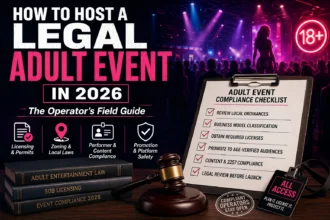
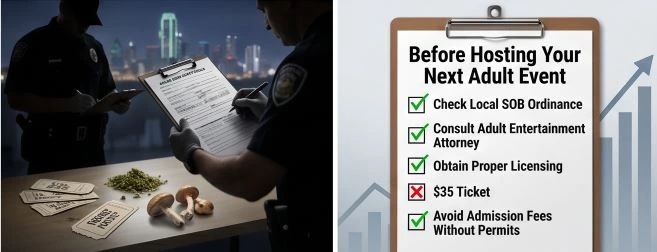
Before running any ticketed adult event, the relevant questions are whether the city or county has a sexually oriented business ordinance and what activities it covers; whether charging admission for an event where adult activity occurs triggers that ordinance regardless of venue type; whether commercial promotion through social media or ticketing platforms affects the classification; and whether filming or content production creates additional permit or zoning requirements.
None of these have universal answers. They depend on local ordinance language, enforcement priorities, and the political climate of the jurisdiction. An attorney familiar with adult entertainment law in the relevant city is not optional; it is the cost of doing business safely.
Creators already navigating adult payment restrictions understand that the financial infrastructure of this industry operates under unusual constraints. The regulatory infrastructure around in-person events is an extension of the same reality.
The Risk Is Growing, Not Shrinking
Dallas tightened its SOB ordinance in 2023 and fought a court challenge to enforce it. That is not an isolated decision. Cities across the country have used local ordinance mechanisms to restrict adult venues throughout the past decade, typically with bipartisan political support and limited organized resistance from the industry.
At the same time, the adult creator economy has expanded significantly. More people are building businesses that combine digital content, in-person events, and community-based revenue streams. As more creators move from platform-based income to real-world experiences, enforcement like the Spayse Studios operation is likely to increase — not decrease. Vice units in major cities are watching the same trends that adult trade press is tracking.
The Spayse Studios case reinforces a simple reality: the sex wasn’t illegal — the business model was. And for operators building in-person revenue without the legal structure to support it, that distinction is the only one that matters.
The case for building a legally compliant in-person operation has never been stronger. A $35 admission fee should not end a business. In Dallas, it did.
Related coverage: Adult Payment Restrictions and What Operators Are Doing About It | Token-Gated Content Models as an OnlyFans Alternative | Creator Monetization Strategies for 2026