



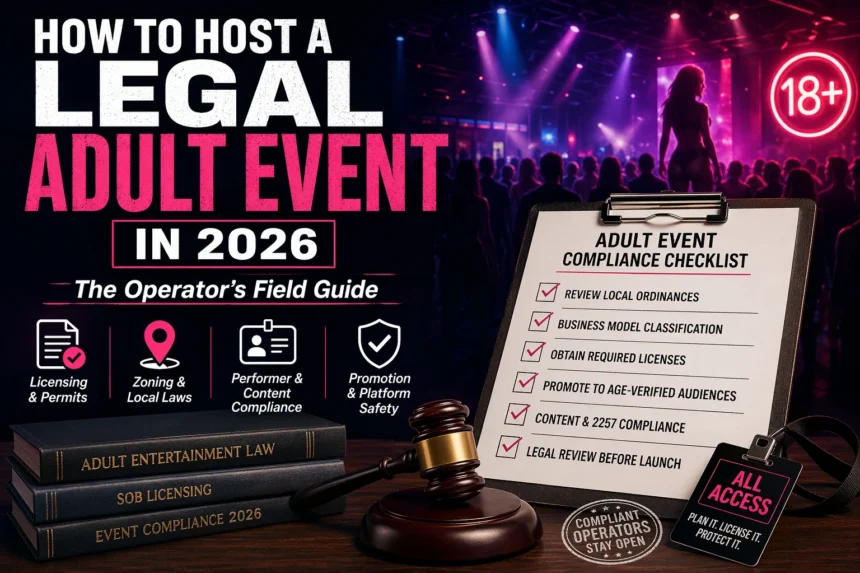
How to Host a Legal Adult Event in 2026: The Operator’s Field Guide
Most adult events do not fail because of what happens inside them. They fail because they were legally classified as a business before the organizer realized it.
- How to Host a Legal Adult Event in 2026: The Operator’s Field Guide
- Quick Picks: Adult Event Compliance Checklist at a Glance
- Why Events Get Shut Down: The Four Most Common Mistakes
- Event Types and Their Legal Risk Profiles
- Tier 1: Licensed Venues (Lower Relative Risk)
- Tier 2: Conventions and Expos (Moderate Risk)
- Tier 3: Pop-Up and Ticketed Events (High Risk)
- Tier 4: Private and Member-Only Events (Highest Misunderstood Risk)
- Step-by-Step: How to Structure a Legal Adult Event
- Step 1: Identify the Applicable Local Ordinance
- Step 2: Define Your Business Model and Legal Structure
- Step 3: Determine Sexually Oriented Business (SOB) Licensing and Permit Requirements
- Operator Quick Check: Are You Legally Covered?
- What This Looks Like When It Goes Wrong
- The Difference Between a Successful Event and a Shutdown
- Start Here If You Are Planning an Adult Event in 2026
That is the reality in 2026. As of 2026, more than 25 U.S. states have active or pending age-verification enforcement frameworks for adult content, and that regulatory logic is increasingly being applied to real-world event promotion and access. Enforcement is better resourced than it was two years ago. The informal gray zone that pop-up organizers and creator meetups operated in for the past decade is shrinking fast. If you are planning to host an adult event, whether that is a ticketed party, a convention appearance, a creator meetup, or an invite-only gathering, you need to structure it like a regulated business from day one
The difference between a successful adult event and a shutdown is not the experience you create inside the room. It is the structure you built before the doors opened.
Mike Bradley
This guide walks through every step: how to identify your legal exposure, how to structure your event model, what licenses and permits you actually need, how to promote safely, and how to handle content creation onsite. It also breaks down how enforcement differs across the states that matter most to adult event organizers right now.
This is not legal advice. Consult a licensed attorney in your jurisdiction before you open a single ticket sale.
Quick Picks: Adult Event Compliance Checklist at a Glance
This adult event compliance checklist covers the minimum steps required to operate legally in most U.S. jurisdictions in 2026.
Why Events Get Shut Down: The Four Most Common Mistakes
Before moving into execution, it helps to understand where most organizers go wrong. These four failure points account for the majority of adult event shutdowns and enforcement actions in the United States.
Mislabeling a commercial event as a private gathering. The label “private” does not determine your legal status; the structure does. If money changes hands, access is organized, and the event repeats, regulators treat it as commercial activity. That standard applies to invite-only gatherings, token-gated meetups, and subscription-tier fan events just as readily as it applies to a nightclub.
More Buzz

Charging admission without the correct license. Ticketing transforms an event into a business transaction. In most jurisdictions, this requires a special event permit, a business license, and, in many cases, a sexually oriented business license before you sell a single ticket. Selling tickets first and asking permission later is the fastest path to shutdown.
Promoting publicly before permits are secured. Social media promotion of an unlicensed adult event creates a paper trail for enforcement. It also triggers platform-level review. Consequently, some organizers lose their promotion channels before their event ever happens.
Mixing live content creation with a general admission event. Filming sexual content at an event, even with performer consent, creates separate federal recordkeeping obligations under 18 U.S.C. 2257. Without the correct records in place before the event, every producer on site carries federal exposure.
Event Types and Their Legal Risk Profiles
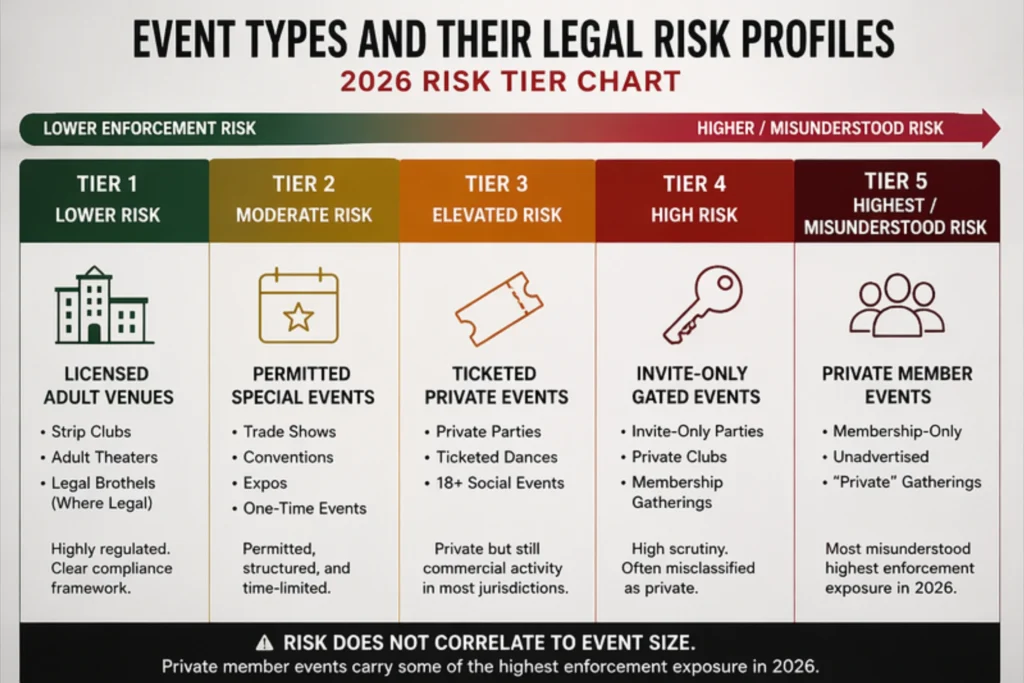
Not all adult events carry the same legal exposure. Therefore, the most useful way to frame compliance is by risk tier, not by event type. Here is how the landscape breaks down in 2026.
Tier 1: Licensed Venues (Lower Relative Risk)
This includes established strip clubs, adult cabarets, adult bookstores with event space, and venues that already operate under a sexually oriented business license. These operators are working inside an existing compliance framework. Zoning is resolved. Licensing is in place. Inspection cycles are established.
However, lower risk does not mean no risk. Established SOBs are still subject to local ordinance changes that can alter operating hours, performer age requirements, and physical layout rules overnight. The Dallas SOB hours ordinance is a clear example: businesses that had operated late-night for years faced mandatory 2 a.m. closure after a unanimous city council vote, with violations carrying fines of up to $4,000 and up to a year in jail. That ordinance survived two federal court challenges and a U.S. Supreme Court review. Licensed venues must monitor local legislative activity continuously, not just at renewal time.
Additionally, Texas SB 315 raised the minimum employment age at sexually oriented businesses to 21. State-level performer age rules can apply to venues that were previously compliant under 18-plus standards.
Operator takeaway: A license is not a shield. It is a baseline that local governments can raise at any time.
Tier 2: Conventions and Expos (Moderate Risk)
Industry trade shows and fan conventions, including events like the AVN Expo, Exxxotica, Southern Pleasure Adult Retail Expo, and Altitude Show, operate under a more complex compliance picture than they may appear from the outside. Ticketing creates a taxable commercial transaction. Vendor activity on the floor may trigger separate licensing requirements. On-site content creation, including creator meet-and-greet content, adds a 2257 recordkeeping layer.
Conventions generally manage compliance through established venue relationships and production experience. However, first-time convention organizers frequently underestimate the permit stack required: special event permits, fire marshal approval, occupancy certificates, liquor licensing if applicable, and in some jurisdictions, additional city-level permits for events above a specific attendance threshold.
Operator takeaway: Scale creates compliance complexity. The larger the event, the longer the permit timeline needs to be.
Tier 3: Pop-Up and Ticketed Events (High Risk)
Warehouse parties, hotel takeovers, branded creator nights, and similar temporary events carry the highest enforcement risk relative to their apparent scale. The combination of a temporary venue, admission fees, and public promotion creates exactly the profile that local enforcement targets.
Temporary venues often lack the existing licensing that established SOBs carry. As a result, the organizer bears full responsibility for identifying applicable ordinances and obtaining every required permit before the first attendee arrives. In most major cities, this process takes weeks, and in some jurisdictions, months. (See our breakdown of real-world enforcement actions affecting adult event operators.)
Promotional visibility is also a key enforcement trigger for pop-up events. High-profile social media promotion without verified age gating or adequate legal structure is frequently what draws initial enforcement attention.
Operator takeaway: If you are running a pop-up, assume you are the compliance layer, not the venue.
Tier 4: Private and Member-Only Events (Highest Misunderstood Risk)
This is where enforcement is moving fastest in 2026. Invite-only gatherings, subscription-tier creator meetups, token-gated community events, and “community” social events may feel informal. However, the moment monetization enters the picture, regulators apply commercial standards.
The key legal question is not whether the event is branded as private. The question is whether access is structured, whether money changes hands, and whether the event recurs. An OnlyFans creator hosting a ticketed fan meetup with adult content is operating a commercial adult event regardless of what the invitation says. A recurring “members only” gathering with a monthly subscription attached operates as a commercial establishment in the eyes of most local ordinances.
This is the segment of the adult event market with the least legal infrastructure and the most active enforcement exposure right now. For an overview of how token-gated access models operate as a parallel framework, see our breakdown of token-gated content platforms.
Operator takeaway: If money or access is structured, regulators will treat it as a business, no matter the label.
Step-by-Step: How to Structure a Legal Adult Event
Step 1: Identify the Applicable Local Ordinance
Adult event compliance starts at the local level, not the state level. Every city and county has its own framework for sexually oriented businesses. Consequently, the first action any organizer should take is a review of the local SOB ordinance for the jurisdiction where the event will be held.
Key questions to answer at this stage include: Does the local ordinance define your event type as a sexually oriented business? What zoning districts permit SOB activity? Are there distance requirements from schools, churches, or other protected locations? What are the hours of operation restrictions?
Do not rely on a general internet search to answer these questions. Pull the actual municipal code. In Dallas, for example, the SOB ordinance requires that sexually oriented businesses operate no closer than 1,000 feet from another sexually oriented business, a church, a school, or a residential area, and the licensing process involves separate zoning verification fees and police department review before a license is issued.
Step 2: Define Your Business Model and Legal Structure
Before you can determine what licenses you need, you need to define what kind of business your event actually is. This determination affects tax classification, licensing requirements, liability exposure, and payment processing eligibility.
Consider the following questions. Is this a one-time event or a recurring operation? Are you selling tickets or requesting donations? Are performers employees, contractors, or guests? Will content be created onsite and monetized later? Each answer changes your compliance obligations.
An LLC structure is appropriate for most adult event organizers because it separates personal liability from event liability. However, some jurisdictions require that the entity applying for an SOB license disclose all officers, directors, and parent corporations. Structure your entity accordingly before you apply.
For a broader look at how payment restrictions affect event monetization, see our coverage of adult payment processing restrictions.
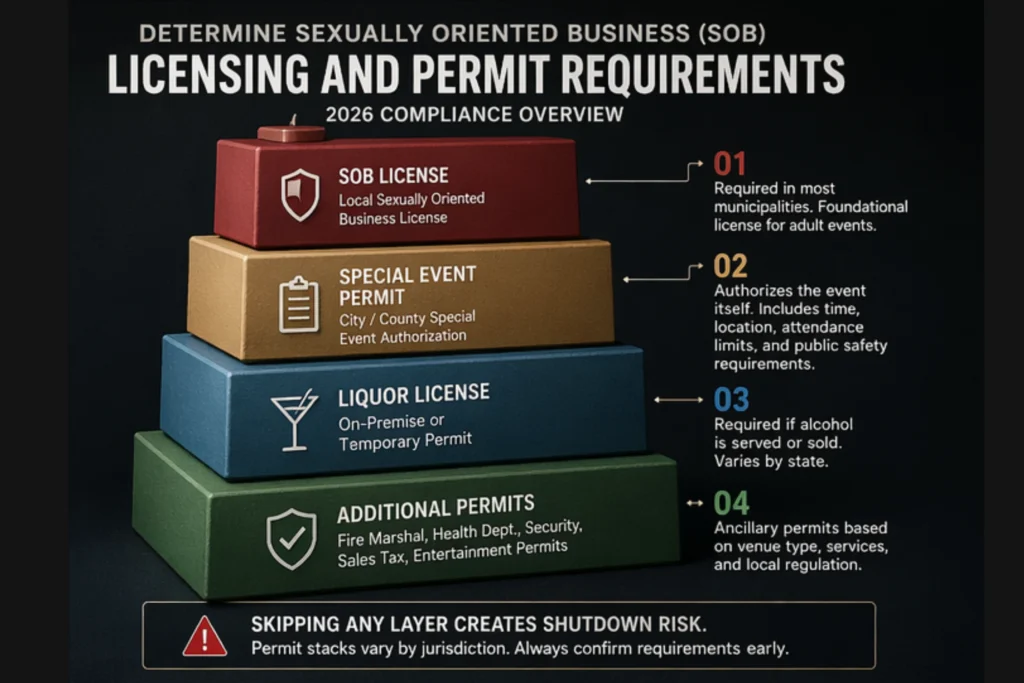
Step 3: Determine Sexually Oriented Business (SOB) Licensing and Permit Requirements
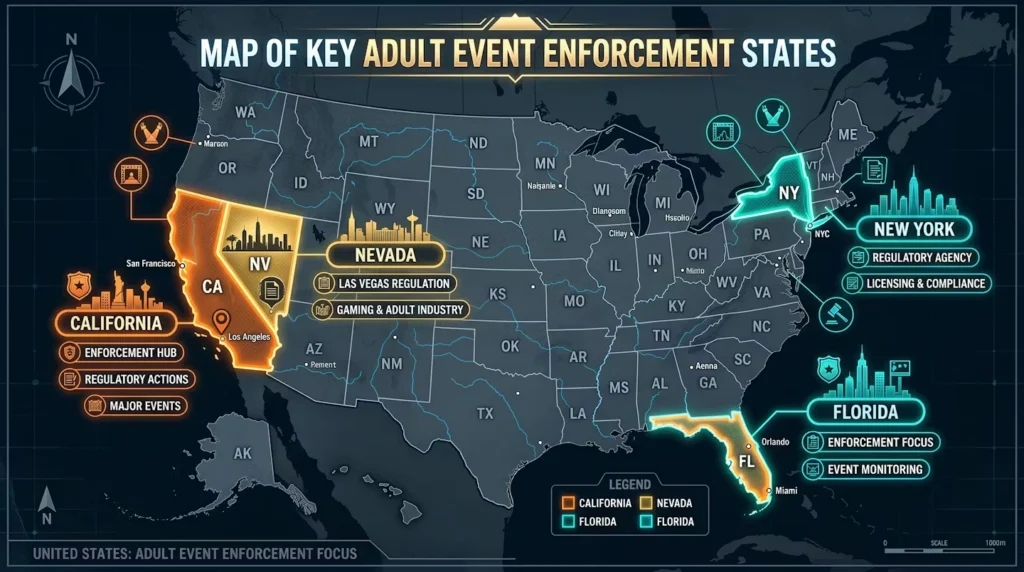
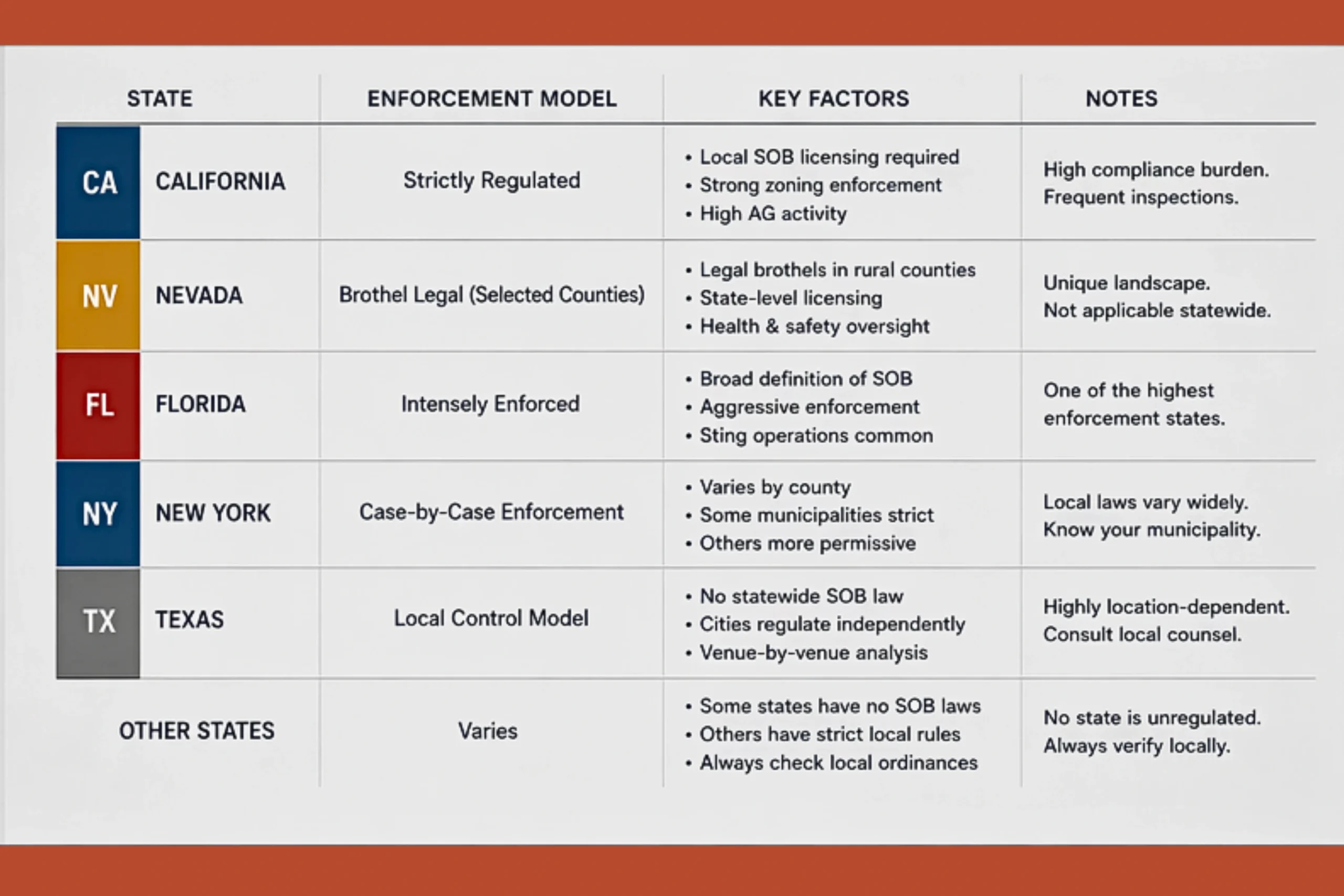
There is no safe state. There are only different enforcement models. Here is how the four key adult event markets operate in 2026.
California
California applies strict zoning controls at the state level, with significant variation at the city level. Los Angeles and San Francisco operate under different local frameworks, and enforcement intensity differs substantially between them. The state’s age verification legislation is in an active rulemaking process as of 2026, with compliance deadlines approaching for digital platforms. Event organizers promoting in California must account for both state-level content rules and the city-specific SOB ordinances applicable to their venue.
Content creation activity at California events carries particular scrutiny. The state has historically been the center of adult entertainment production regulation, and its enforcement posture on performer documentation and age verification is aggressive relative to most other jurisdictions.
Florida
Florida is currently one of the most active enforcement environments in the adult industry. The Florida Attorney General has filed suit against major adult content providers for age verification non-compliance, and that enforcement posture extends to how adult events operate and promote in the state.
Miami and Miami Beach apply specific local ordinance requirements on top of state law. Miami Beach requires a minimum $1 million general liability policy for special events, with the city listed as additional insured, and maintains a noise ordinance enforceable around the clock on both public and private property. The city reserves the right to increase insurance requirements based on the nature of the event — a provision that applies with particular force to adult-oriented programming.
High visibility is a key enforcement trigger in South Florida. Events that generate significant social media attention or that operate in tourist-heavy areas attract regulatory scrutiny proportionate to their public profile.
Nevada
Nevada is frequently misunderstood as an anything-goes environment for adult events. That misreading creates real compliance risk. Adult activity is legal in certain specific contexts in Nevada, but those contexts are defined by licensing, zoning, and the type of activity involved. Events that assume Nevada’s permissive reputation exempts them from compliance are routinely wrong.
In Las Vegas specifically, the relationship between nudity and alcohol service is governed by clear rules that vary by license type. Furthermore, events at hotel properties or convention venues operate under the host property’s licensing framework, which may limit what is permissible on site regardless of what the organizer intends.
New York
New York City applies one of the most complex licensing frameworks for adult entertainment in the country. The cabaret license required for venues hosting live music or dancing is administered by the Department of Consumer Affairs, involves background checks and venue layout review, and can take months to obtain. Denial rates are meaningful.
The state’s zoning restrictions on sexually oriented businesses are aggressive, and the attorney general has been active in age verification enforcement for digital platforms throughout 2025 and into 2026. New York City’s density and visibility make it a high-scrutiny environment for adult events of any scale.
Operator Quick Check: Are You Legally Covered?
If you cannot check every box below, your event is exposed to enforcement risk.
Pre-Planning
- Pulled and reviewed local SOB ordinance for event jurisdiction
- Confirmed venue zoning permits SOB activity at that location
- Verified no distance violations from protected locations (schools, churches, residential)
- Determined business model classification (one-time vs. recurring, commercial vs. private)
- Established LLC or appropriate entity structure
Licensing and Permits
- Identified full permit stack required (SOB license, special event permit, liquor permit, fire marshal, occupancy)
- Confirmed all application timelines against event date
- Obtained all required permits before beginning promotion
Content and Performer Compliance
- Established 2257 recordkeeping system with designated custodian
- Collected government-issued ID and consent documentation for all performers
- Verified all performers meet minimum age requirements under applicable state law (21+ in Texas under SB 315)
Promotion
- Confirmed permits are in place before any public promotion begins
- Limited promotion to age-verified channels or platforms
- Removed explicit content from any general-audience-facing promotional materials
Legal Review
- Engaged adult entertainment attorney for jurisdiction-specific review
- Reviewed entity structure for SOB license application compatibility
- Confirmed payment processor compliance requirements are met
What This Looks Like When It Goes Wrong
The Dallas clubs that attempted to rebrand as dining establishments after 2 a.m. to avoid the SOB hours ordinance provide a useful case study. After the 5th U.S. Circuit Court of Appeals upheld the ordinance, a federal judge ruled clearly that a business classified as a sexually oriented business remains subject to that classification around the clock, not just during the hours when explicit activity occurs. The attempted workaround failed. Operating history and license classification determined legal status, not what the business was doing at any given moment.
That principle applies broadly to adult event organizers in 2026. The structure of your event, how access is controlled, how revenue is collected, and how performers are engaged determines your legal classification. The label you put on it does not.
The Difference Between a Successful Event and a Shutdown
The difference between a successful adult event and a shutdown is not the experience you create inside the room. It is the structure you built before the doors opened.
In 2026, that structure requires more than it did even two years ago. Enforcement is better resourced. Age verification requirements are expanding from the digital world into the physical one. And the informal arrangements that allowed pop-up organizers and creator meetups to operate without full compliance infrastructure are facing increasing scrutiny.
The operators building durable event businesses right now are treating compliance as a core operational function, not a box to check before launch. That means legal review before entity formation, permits before promotion, and recordkeeping systems before the first performer steps on site.
That is the standard. Build to it.
Start Here If You Are Planning an Adult Event in 2026
If you are charging admission, promoting publicly, or filming content onsite, you are operating a regulated business, whether you realize it or not.
Get the compliance structure right before you sell your first ticket.
Download the Adult Event Compliance System (2026 Edition). Built for operators, not theory, this is the exact framework used to launch compliant events in regulated markets. Includes the complete checklist, common failure scenarios, permit stack example by market, and a pre-launch timeline. Used by operators planning events in Texas, Florida, Nevada, and California. [DOWNLOAD LINK]
Need Legal Backup? Browse verified adult entertainment attorneys through the XBIZ legal directory.
Read Next: